
游戏人生
Chinese-made infrared telescope with domestic detectors achieves astronomical imaging, reducing foreign reliance_我的网站

A |
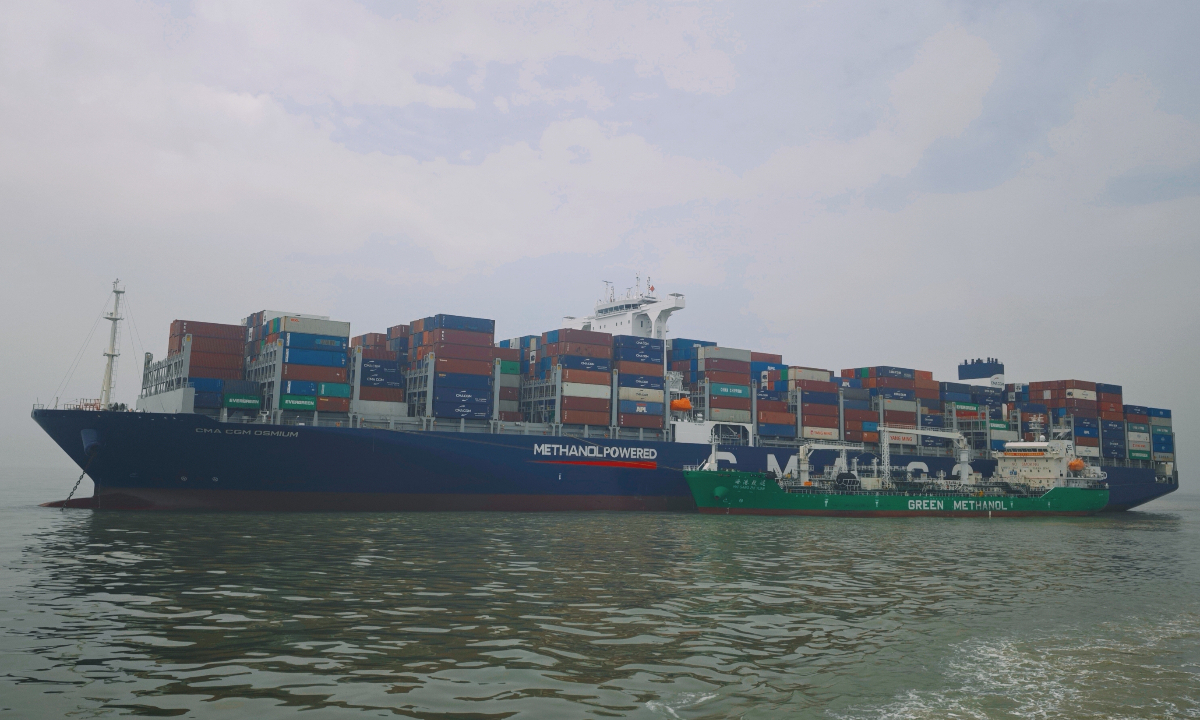
Shanghai Port has for the first time successfully completed simultaneously the bunkering of two types of green fuel for two international vessels at the offshore anchorage, marking a milestone in the port’s ability to provide diversified and large-scale marine fuel supplies, chinanews.com reported on Sunday.
Haigang Zhiyuan, a methanol bunkering vessel, successfully completed the bunkering of domestic-produced biomethanol to methanol-powered containership CMA CGM Osmium, which flies the Maltese flag, while Haigang Weilai, a liquefied natural gas (LNG) bunkering vessel, successfully completed the bunkering of LNG to Kota Elan, a Singapore-flagged dual-fuel LNG container ship at the Lühuashan Anchorage off Shanghai from Saturday to Sunday.
Most of the biomethanol supplied in the bunkering operation was produced by Shanghai Electric’s Taonan project. Which means the methanol feedstock was transported by land from Taonan, in Northeast China’s Jilin Province, to Dalian Port in Northeast China’s Liaoning Province, then shipped by sea to storage tanks in Shanghai, before being used for vessel bunkering at Shanghai Port. This established a cross-regional supply chain linking production in Jilin, transshipment in Dalian and bunkering in Shanghai, said the report.
The cross-provincial supply chain from Northeast China to Shanghai expands the market for domestic biomethanol and highlights progress in building a north-to-south green fuel transportation corridor, according to the report.

According to the Yangshan Border Inspection Station, the two vessels receiving the bunkering service have different sailing schedules. the CMA CGM Osmium is en route from Qingdao in Shandong Province to Ningbo in Zhejiang Province via Shanghai, while the newly built Kota Elan will conduct sea trials after bunkering.
Completing clean-fuel bunkering at an anchorage cuts berth, tugboat and pilotage costs, and reduces vessel waiting times, which lowers the energy replenishment costs for international vessels and strengthens Shanghai Port’s overall competitiveness as a shipping hub, chinanews.com reported.
Global Times
。
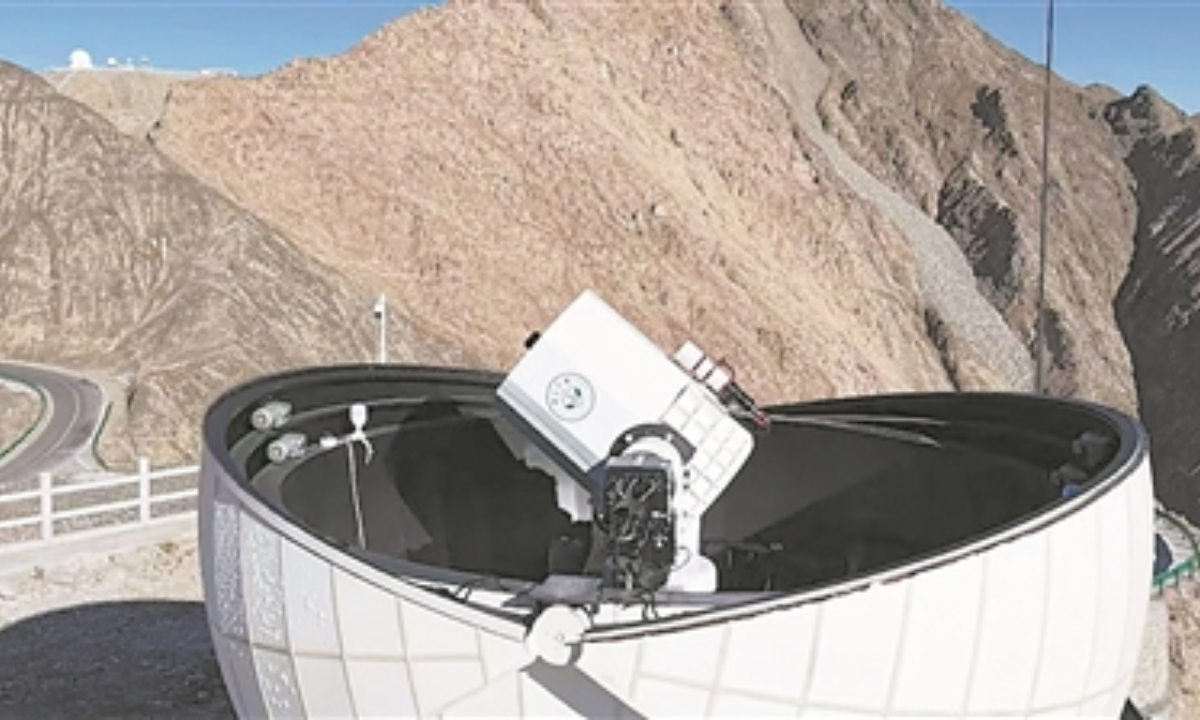
Chinese scientists on Wednesday released the first complete set of observational images captured by China's new-generation ground-based infrared telescope, filling a gap in the country's near-infrared astronomical observation capabilities and reducing reliance on foreign infrared detector technology, China News Service reported on Wednesday.
The 80-centimeter near-infrared telescope was installed at Saishiteng Mountain, Lenghu township, Northwest China's Qinghai Province in October 2024. Jointly developed by Sun Yat-sen University and several partner institutions, the telescope is China's first to achieve scientific imaging in the 1.2-micrometer J band and 2.2-micrometer K band using domestically developed scientific-grade InGaAs and HgCdTe detectors.
The telescope enables unattended remote operations, and can lock onto any target in the sky within 15 seconds. Its infrared capability allows it to see through interstellar dust, enabling it to observe cold and distant celestial objects that are difficult for optical telescopes to capture.
According to Ma Bin, a professor at the School of Physics and Astronomy, Sun Yat-sen University who led the research team that released the infrared telescope's observational images, all three of the telescope's core astronomical observation capabilities were fully validated during operation.
It rapidly responded to and tracked multiple gamma-ray bursts and supernova events, recording the evolution of their infrared afterglows following the explosions. It continuously monitored brown dwarfs, precisely capturing periodic variations in their atmospheric brightness. Using image-stacking technology, it also observed active galaxies billions of light-years away.
Since its deployment in Lenghu, the system has supported infrared observations for more than 10 Chinese research institutions, accumulating valuable experience for the construction of future large-scale infrared telescopes.
Lenghu township, where the world-class astronomical observation base takes shape, is hailed as "the most Mars-like place on the Earth." The astronomical observation base was said to be an astronomical observation site comparable to the top ones in the world by a Nature article published on August 18, 2021, according to the Chinese Academy of Sciences.
Once prospered in 1950s due to its rich petroleum resources, Lenghu is now becoming a premier astronomical observation site and Mars-themed tourist destination, according to Xinhua News Agency.
Global Times
。
Current article:http://gbrifmk.hunyoduozuiaopoulun.buzz/news/20260826_93336.html
Published on:14:47:55
最新文章
- 大冷门!世界第一特鲁姆普一轮游
- 新加坡25fall留学:NUS人文社科学院9月开放专业汇总介绍
- 需求扩张叠加全球供应紧张共同推升铜价,LME铜逼近14500美元历史高位
- 8月国补持续加码!学生如何买iPhone17、iPad、Mac、Watch最全省钱攻略!教育优惠+15%国补+京东大额券叠加+避坑指南!
- “国际滨”如何书写中非数字合作新篇章?
- Tata Winger Plus हुई लॉन्च, 9 सीटर में मिलेगा ज्यादा आराम और शानदार फीचर्स, कितनी है कीमत
- 国家发展改革委召开“六网协同”协调推进工作会,研究“六张网”投融资机制和支持政策
- 国宝面包做法独一无二 资深师傅揭露近十种别名
- 苹果homepod起价:2799元
- Twitter Baffled by Toronto Police Searching For a Missing Woman... With a Goatee
标签云